-
|
-
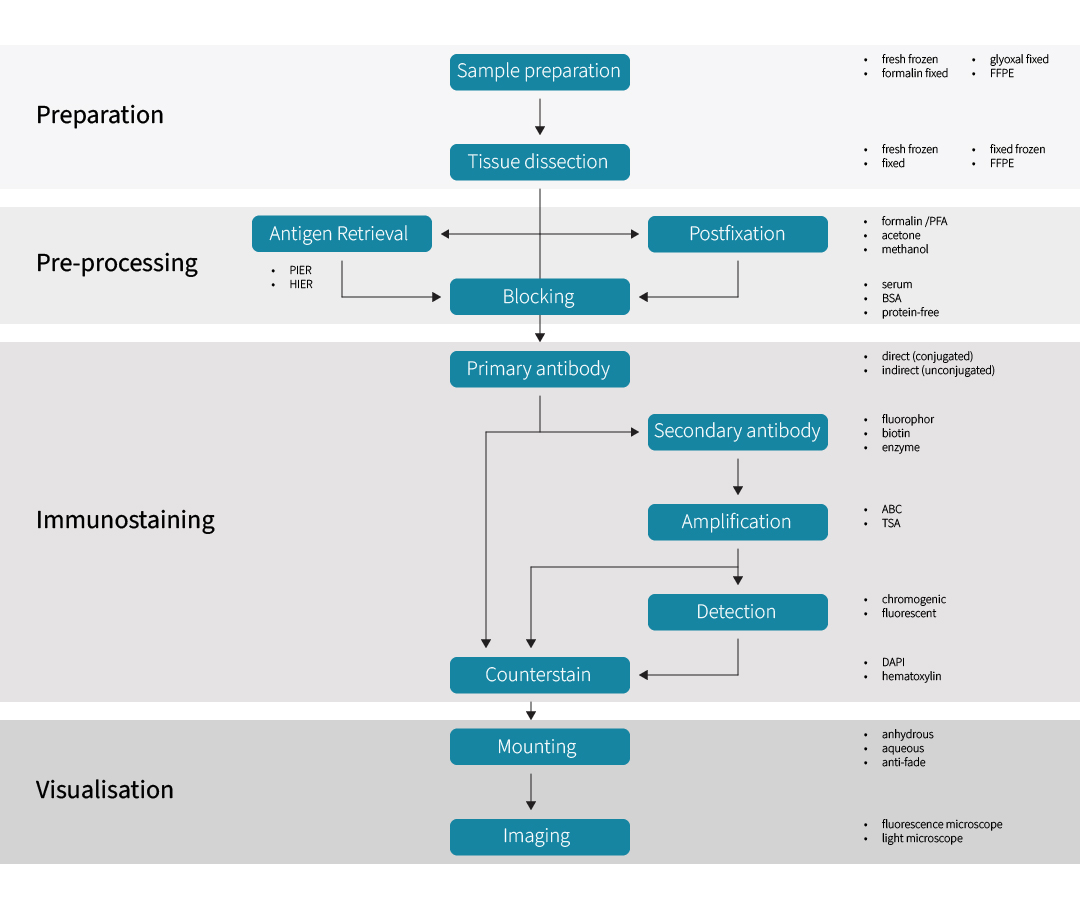
Immunohistochemistry is a technique used to detect proteins in tissue sections by employing specific antibodies. The workflow (Figure 1) begins with sample preparation, during which the tissue is removed and fixed or cryopreserved to maintain its morphology and antigenicity. The type of tissue preparation determines whether tissue dissection and pretreatment are necessary, such as post-fixation or antigen retrieval. The immunostaining process itself follows a common sequence across most IHC protocols. It begins with blocking to reduce non-specific binding of antibodies to tissue components. Sections are then incubated with the primary antibody, which specifically recognizes the antigen of interest. Depending on the antibody format and detection system, this may be followed by additional detection and amplification steps. For example, if the primary antibody is directly labeled (e.g., with a fluorophore), signal can be visualized immediately. If the primary antibody is unlabeled, a secondary antibody conjugated to an enzyme (such as HRP or alkaline phosphatase) or a fluorophore is applied, often with amplification systems (e.g., ABC, tyramide signal amplification) to enhance sensitivity. Every step has its own specific pitfalls.
Certificates
ISO 9001 2015 Quality Management System and Green Lab Platinum certification level for sustaining laboratory processes.


Newsletter
Sign up for our newsletter and get the latest updates and news.