Tailor-made Antibodies
and Tools for Life Science
Home | | | | | Technical Support

alpha-Tubulin antibody - 302 217

alpha-Tubulin is a major cytoskeleton protein
Rat monoclonal purified IgG
Cat. No.: 302 217
Amount: 100 µg
Price: $420.00

Cat. No. 302 217 100 µg purified IgG, lyophilized. Azide was added before lyophilization. For reconstitution add 100 µl H2O to get a 1mg/ml solution in PBS. Then aliquot and store at -20°C to -80°C until use.
Antibodies should be stored at +4°C when still lyophilized. Do not freeze!
Applications
 
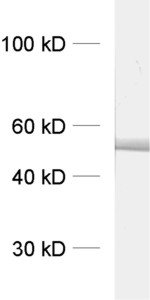
WB: 1 : 1000 up to 1 : 5000 (AP staining) gallery  
IP: not tested yet
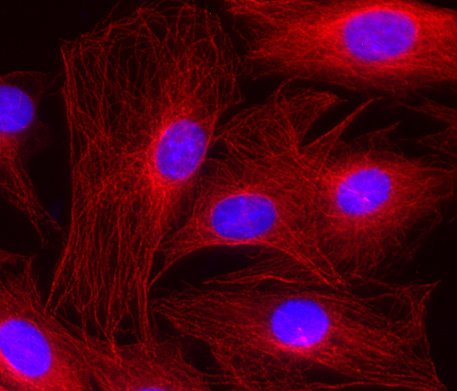
ICC: 1 : 200 up to 1 : 500 gallery  
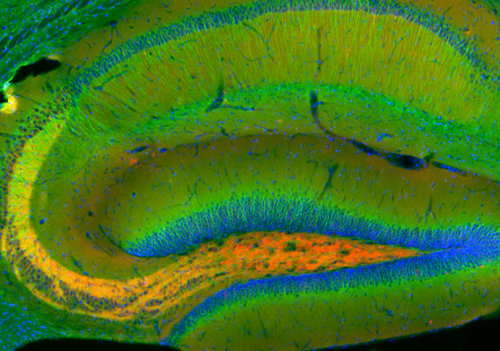
IHC: 1 : 400 gallery  
IHC-P: not tested yet

Western blot (WB); separation of proteins by PAGE and subsequent transfer to a membrane. Detection of target molecules is carried out with antibodies. Some antibodies require special sample preparation steps. For details, please refer to the “Remarks” section.

Immunoprecipitation (IP); Immunoisolation or pulldown of a target molecule using an antibody. For details and product specific hints, please refer to the ”Remarks” section.

Immunocytochemistry (ICC) on 4% PFA fixed cells. Immunoreactivity is usually revealed by fluorescence. Some antibodies require special fixation methods. For details, please refer to the “Remarks” section.

Immunohistochemistry (IHC) on 4% PFA perfusion fixed tissue with 24h PFA post fixation. Immunoreactivity is usually revealed by fluorescence or a chromogenic substrate. Some antibodies require special fixation methods or antigen retrieval steps. For details, please refer to the ”Remarks” section.

Immunohistochemistry (IHC-P) of formalin fixed, paraffin embedded (FFPE) tissue (some antibodies require special antigen retrieval steps, please refer to the ”Remarks” section). Immunoreactivity is usually revealed by fluorescence or a chromogenic substrate.

Clone 37B5
Subtype IgG1
Immunogen Synthetic peptide corresponding to AA 443 to 449 from rat α-Tubulin 1A (UniProt Id: P68370-1)
Reactivity Reacts with: mammals, chicken.
Other species not tested yet.
Specificity Specific for α-tubulin.
Data sheet 302_217.pdf

References for alpha-Tubulin - 302 217

Centrosome-dependent microtubule modifications set the conditions for axon formation.
Meka DP, Kobler O, Hong S, Friedrich CM, Wuesthoff S, Henis M, Schwanke B, Krisp C, Schmuelling N, Rueter R, Ruecker T, et al.
Cell reports (2022) 393: 110686. 302 217 WB, ICC; tested species: rat
Developmental switch in the kinase dependency of long-term potentiation depends on expression of GluA4 subunit-containing AMPA receptors.
Luchkina NV, Huupponen J, Clarke VR, Coleman SK, Keinänen K, Taira T, Lauri SE
Proceedings of the National Academy of Sciences of the United States of America (2014) 11111: 4321-6. 302 217 WB; tested species: mouse,rat
Ongoing intrinsic synchronous activity is required for the functional maturation of CA3-CA1 glutamatergic synapses.
Huupponen J, Molchanova SM, Lauri SE, Taira T
Cerebral cortex (New York, N.Y. : 1991) (2013) 2311: 2754-64. 302 217 WB; tested species: rat
Centrosome-dependent microtubule modifications set the conditions for axon formation.
Meka DP, Kobler O, Hong S, Friedrich CM, Wuesthoff S, Henis M, Schwanke B, Krisp C, Schmuelling N, Rueter R, Ruecker T, et al.
Cell reports (2022) 393: 110686. 302 217 WB, ICC; tested species: rat
Cat. No.: 302 217
Amount: 100 µg
Price: $420.00
Centrosome-dependent microtubule modifications set the conditions for axon formation.
Meka DP, Kobler O, Hong S, Friedrich CM, Wuesthoff S, Henis M, Schwanke B, Krisp C, Schmuelling N, Rueter R, Ruecker T, et al.
Cell reports (2022) 393: 110686. 302 217 WB, ICC; tested species: rat
Developmental switch in the kinase dependency of long-term potentiation depends on expression of GluA4 subunit-containing AMPA receptors.
Luchkina NV, Huupponen J, Clarke VR, Coleman SK, Keinänen K, Taira T, Lauri SE
Proceedings of the National Academy of Sciences of the United States of America (2014) 11111: 4321-6. 302 217 WB; tested species: mouse,rat
Ongoing intrinsic synchronous activity is required for the functional maturation of CA3-CA1 glutamatergic synapses.
Huupponen J, Molchanova SM, Lauri SE, Taira T
Cerebral cortex (New York, N.Y. : 1991) (2013) 2311: 2754-64. 302 217 WB; tested species: rat
Centrosome-dependent microtubule modifications set the conditions for axon formation.
Meka DP, Kobler O, Hong S, Friedrich CM, Wuesthoff S, Henis M, Schwanke B, Krisp C, Schmuelling N, Rueter R, Ruecker T, et al.
Cell reports (2022) 393: 110686. 302 217 WB, ICC; tested species: rat
Background

Microtubules are involved in a wide variety of intracellular events including cell division, intracellular transport and secretion, axonal transport, and maintenance of cell morphology. They are composed of tubulin, a heterodimeric protein, consisting of two polypeptides, α-tubulin and β-tubulin (1). 
α Tubulin undergoes numerous post-translational modifications that include tyrosination-detyrosination and deglutamylation, phosphorylation, acetylation, polyglutamylation, and polyglycylation. In one of the major posttranslational modifications, the C-terminal tyrosine residue in α-tubulin is added or removed reversibly, producing Glu-tubulin (after detyrosination) and Tyr-tubulin (with re-added tyrosine). Early stages of cell development are often enriched in Tyr tubulin, whereas mature cells show increased Glu tubulin in stable structures. Some microtubule associated proteins (MAPs), motor proteins like kinesins, or stabilizing factors have different affinities for Glu- or Tyr-tubulin (2,3,4).
A third variant of detyrosinated α-tubulin is Δ2-tubulin which lacks the C-terminal glutamic acid. It cannot be tyrosinated by tyrosine ligase and is one of the dominant α-tubulin isoforms in neurons (5).