Tailor-made Antibodies
and Tools for Life Science
Home | | | | | Technical Support

alpha-Tubulin antibody - 302 203

alpha-Tubulin is a major cytoskeleton protein
Rabbit polyclonal purified antibody
Cat. No.: 302 203
Amount: 100 µg
Price: $380.00

Cat. No. 302 203 100 µg specific antibody, lyophilized. Affinity purified with the immunogen. Albumin was added for stabilization. For reconstitution add 100 µl H2O to get a 1mg/ml solution in PBS. Then aliquot and store at -20°C to -80°C until use.
Antibodies should be stored at +4°C when still lyophilized. Do not freeze!
Applications
 
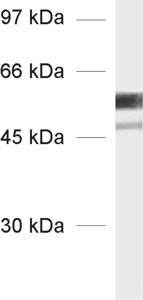
WB: 1 : 1000 up to 1 : 5000 (AP staining) gallery  
IP: not recommended
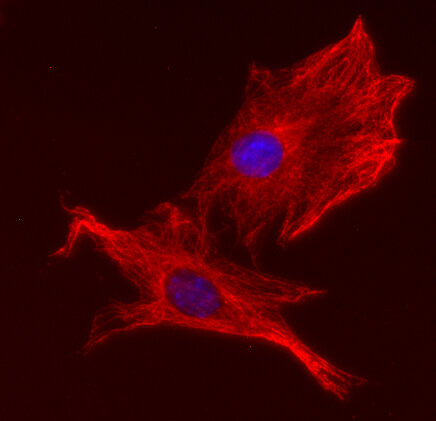
ICC: 1 : 100 up to 1 : 1000 gallery  
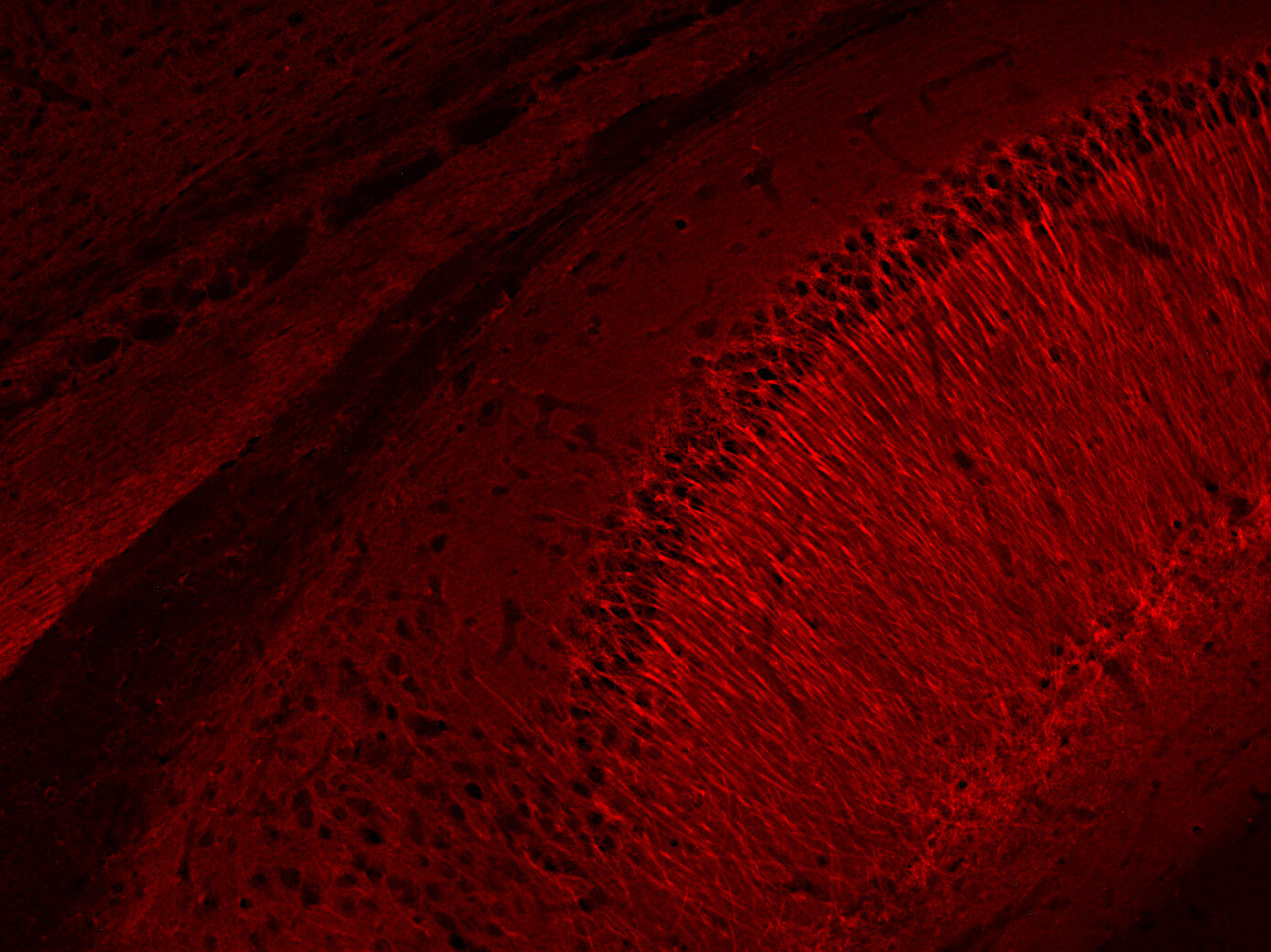
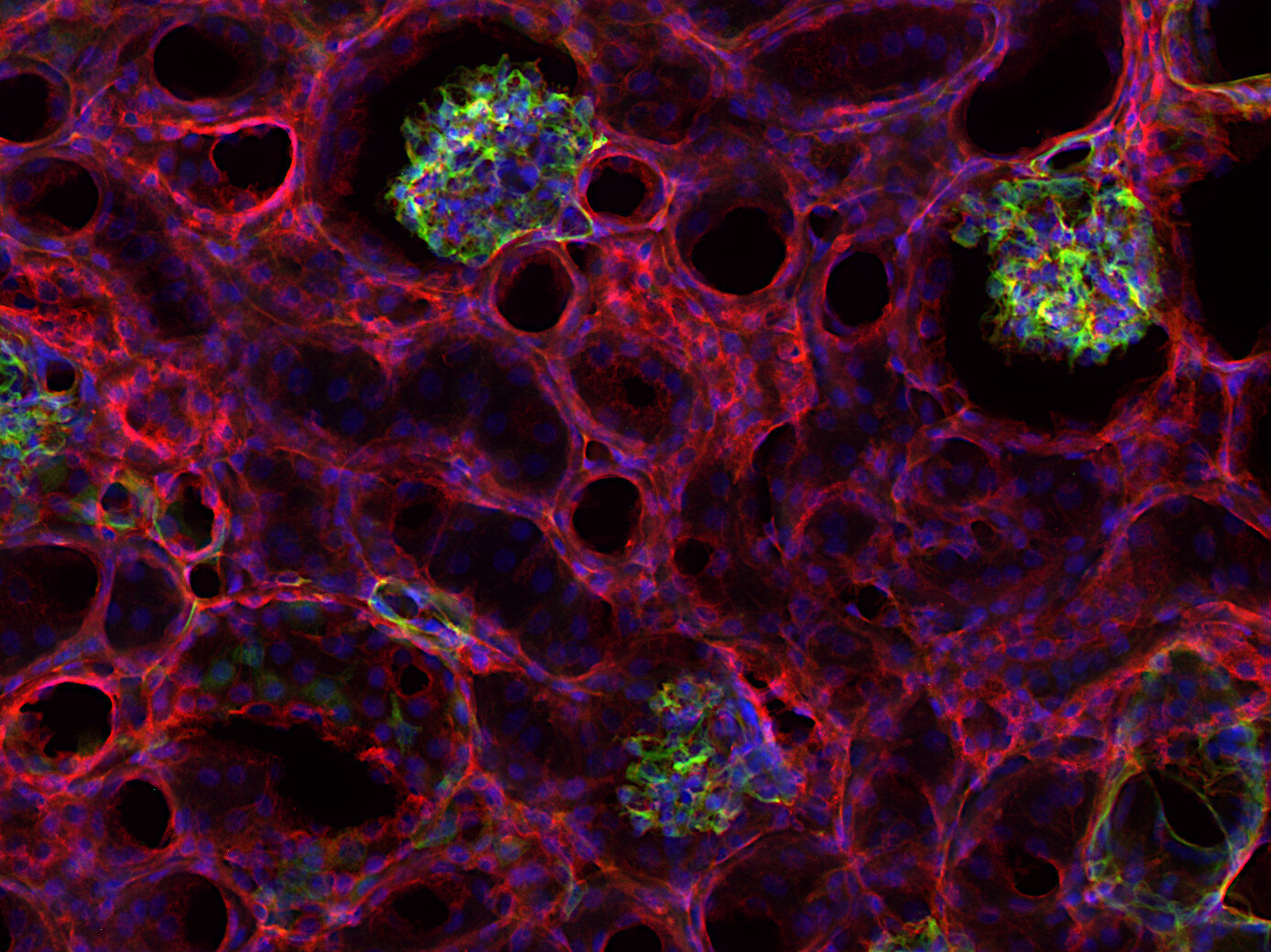
IHC: 1 : 400 gallery  
IHC-P: not tested yet
ELISA: yes (see remarks)

Western blot (WB); separation of proteins by PAGE and subsequent transfer to a membrane. Detection of target molecules is carried out with antibodies. Some antibodies require special sample preparation steps. For details, please refer to the “Remarks” section.

Immunoprecipitation (IP); Immunoisolation or pulldown of a target molecule using an antibody. For details and product specific hints, please refer to the ”Remarks” section.

Immunocytochemistry (ICC) on 4% PFA fixed cells. Immunoreactivity is usually revealed by fluorescence. Some antibodies require special fixation methods. For details, please refer to the “Remarks” section.

Immunohistochemistry (IHC) on 4% PFA perfusion fixed tissue with 24h PFA post fixation. Immunoreactivity is usually revealed by fluorescence or a chromogenic substrate. Some antibodies require special fixation methods or antigen retrieval steps. For details, please refer to the ”Remarks” section.

Immunohistochemistry (IHC-P) of formalin fixed, paraffin embedded (FFPE) tissue (some antibodies require special antigen retrieval steps, please refer to the ”Remarks” section). Immunoreactivity is usually revealed by fluorescence or a chromogenic substrate.

Enzyme-linked immunosorbent assay (ELISA); a frequently employed method to quantify target-molecules in solution. The detection of some proteins requires special solubilization steps. For further information, please refer to the „Remarks“ section.

Immunogen Synthetic peptide corresponding to AA 443 to 449 from rat α-tubulin (UniProt Id: P68370) (UniProt Id: P68370-1)
Reactivity Reacts with: human, rat (P68370-1), mouse, mammals, chicken.
Other species not tested yet.
Specificity Recognizes glu- and tyr-α-tubulin and Δ2-tubulin with a preference for glu- and Δ2-tubulin.
Remarks

ELISA: Suitable as detector antibody for sandwich-ELISA. Please refer to the protocol for suitable capture antibodies.

Data sheet 302_203.pdf

References for alpha-Tubulin - 302 203

Neuroplastin Expression in Male Mice Is Essential for Fertility, Mating, and Adult Testosterone Levels.
Chen J, Lin X, Bhattacharya S, Wiesehöfer C, Wennemuth G, Müller K, Montag D
International journal of molecular sciences (2023) 251: . 302 203 WB; tested species: mouse
Composition of isolated synaptic boutons reveals the amounts of vesicle trafficking proteins.
Wilhelm BG, Mandad S, Truckenbrodt S, Kröhnert K, Schäfer C, Rammner B, Koo SJ, Claßen GA, Krauss M, Haucke V, Urlaub H, et al.
Science (New York, N.Y.) (2014) 3446187: 1023-8. 302 203 WB, ICC, IHC; tested species: mouse,rat
Glyoxal as an alternative fixative to formaldehyde in immunostaining and super-resolution microscopy.
Richter KN, Revelo NH, Seitz KJ, Helm MS, Sarkar D, Saleeb RS, D'Este E, Eberle J, Wagner E, Vogl C, Lazaro DF, et al.
The EMBO journal (2018) 371: 139-159. 302 203 ICC; tested species: mouse
Composition of isolated synaptic boutons reveals the amounts of vesicle trafficking proteins.
Wilhelm BG, Mandad S, Truckenbrodt S, Kröhnert K, Schäfer C, Rammner B, Koo SJ, Claßen GA, Krauss M, Haucke V, Urlaub H, et al.
Science (New York, N.Y.) (2014) 3446187: 1023-8. 302 203 WB, ICC, IHC; tested species: mouse,rat
Composition of isolated synaptic boutons reveals the amounts of vesicle trafficking proteins.
Wilhelm BG, Mandad S, Truckenbrodt S, Kröhnert K, Schäfer C, Rammner B, Koo SJ, Claßen GA, Krauss M, Haucke V, Urlaub H, et al.
Science (New York, N.Y.) (2014) 3446187: 1023-8. 302 203 WB, ICC, IHC; tested species: mouse,rat
Microtubules as a versatile reference standard for expansion microscopy.
Chowdhury R, Mimoso T, Chouaib AA, Mougios N, Krah D, Opazo F, Köster S, Rizzoli SO, Shaib AH
Communications biology (2025) 81: 499. 302 203 ExM; tested species: human
One-step nanoscale expansion microscopy reveals individual protein shapes.
Shaib AH, Chouaib AA, Chowdhury R, Altendorf J, Mihaylov D, Zhang C, Krah D, Imani V, Spencer RKW, Georgiev SV, Mougios N, et al.
Nature biotechnology (2024) : . 302 203 ExM; tested species: rat
Heat denaturation enables multicolor X10-STED microscopy.
Saal KA, Shaib AH, Mougios N, Crzan D, Opazo F, Rizzoli SO
Scientific reports (2023) 131: 5366. 302 203 ExM; tested species: rat
Cat. No.: 302 203
Amount: 100 µg
Price: $380.00
Neuroplastin Expression in Male Mice Is Essential for Fertility, Mating, and Adult Testosterone Levels.
Chen J, Lin X, Bhattacharya S, Wiesehöfer C, Wennemuth G, Müller K, Montag D
International journal of molecular sciences (2023) 251: . 302 203 WB; tested species: mouse
Composition of isolated synaptic boutons reveals the amounts of vesicle trafficking proteins.
Wilhelm BG, Mandad S, Truckenbrodt S, Kröhnert K, Schäfer C, Rammner B, Koo SJ, Claßen GA, Krauss M, Haucke V, Urlaub H, et al.
Science (New York, N.Y.) (2014) 3446187: 1023-8. 302 203 WB, ICC, IHC; tested species: mouse,rat
Glyoxal as an alternative fixative to formaldehyde in immunostaining and super-resolution microscopy.
Richter KN, Revelo NH, Seitz KJ, Helm MS, Sarkar D, Saleeb RS, D'Este E, Eberle J, Wagner E, Vogl C, Lazaro DF, et al.
The EMBO journal (2018) 371: 139-159. 302 203 ICC; tested species: mouse
Composition of isolated synaptic boutons reveals the amounts of vesicle trafficking proteins.
Wilhelm BG, Mandad S, Truckenbrodt S, Kröhnert K, Schäfer C, Rammner B, Koo SJ, Claßen GA, Krauss M, Haucke V, Urlaub H, et al.
Science (New York, N.Y.) (2014) 3446187: 1023-8. 302 203 WB, ICC, IHC; tested species: mouse,rat
Composition of isolated synaptic boutons reveals the amounts of vesicle trafficking proteins.
Wilhelm BG, Mandad S, Truckenbrodt S, Kröhnert K, Schäfer C, Rammner B, Koo SJ, Claßen GA, Krauss M, Haucke V, Urlaub H, et al.
Science (New York, N.Y.) (2014) 3446187: 1023-8. 302 203 WB, ICC, IHC; tested species: mouse,rat
Microtubules as a versatile reference standard for expansion microscopy.
Chowdhury R, Mimoso T, Chouaib AA, Mougios N, Krah D, Opazo F, Köster S, Rizzoli SO, Shaib AH
Communications biology (2025) 81: 499. 302 203 ExM; tested species: human
One-step nanoscale expansion microscopy reveals individual protein shapes.
Shaib AH, Chouaib AA, Chowdhury R, Altendorf J, Mihaylov D, Zhang C, Krah D, Imani V, Spencer RKW, Georgiev SV, Mougios N, et al.
Nature biotechnology (2024) : . 302 203 ExM; tested species: rat
Heat denaturation enables multicolor X10-STED microscopy.
Saal KA, Shaib AH, Mougios N, Crzan D, Opazo F, Rizzoli SO
Scientific reports (2023) 131: 5366. 302 203 ExM; tested species: rat
Background

Microtubules are involved in a wide variety of intracellular events including cell division, intracellular transport and secretion, axonal transport, and maintenance of cell morphology. They are composed of tubulin, a heterodimeric protein, consisting of two polypeptides, α-tubulin and β-tubulin (1). 
α Tubulin undergoes numerous post-translational modifications that include tyrosination-detyrosination and deglutamylation, phosphorylation, acetylation, polyglutamylation, and polyglycylation. In one of the major posttranslational modifications, the C-terminal tyrosine residue in α-tubulin is added or removed reversibly, producing Glu-tubulin (after detyrosination) and Tyr-tubulin (with re-added tyrosine). Early stages of cell development are often enriched in Tyr tubulin, whereas mature cells show increased Glu tubulin in stable structures. Some microtubule associated proteins (MAPs), motor proteins like kinesins, or stabilizing factors have different affinities for Glu- or Tyr-tubulin (2,3,4).
A third variant of detyrosinated α-tubulin is Δ2-tubulin which lacks the C-terminal glutamic acid. It cannot be tyrosinated by tyrosine ligase and is one of the dominant α-tubulin isoforms in neurons (5).