Tailor-made Antibodies
and Tools for Life Science
Home | | | | | Technical Support

Kv7.3 antibody - 368 003 K.D.

Kv7.3 is a potassium channel widely expressed throughout the brain
Rabbit polyclonal purified antibody
Cat. No.: 368 003
Amount: 50 µg
Price: $380.00

Cat. No. 368 003 50 µg specific antibody, lyophilized. Affinity purified with the immunogen. Albumin and azide were added for stabilization. For reconstitution add 50 µl H2O to get a 1mg/ml solution in PBS. Then aliquot and store at -20°C to -80°C until use.
Antibodies should be stored at +4°C when still lyophilized. Do not freeze!
Applications
 
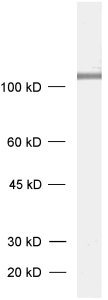
WB: 1 : 1000 (AP staining) gallery  
IP: not tested yet
ICC: not recommended
IHC: not tested yet
IHC-P (FFPE): not tested yet
ExM: external dataThis antibody has been successfully applied for this method (see application-specific references). (see remarks)

Western blot (WB); separation of proteins by PAGE and subsequent transfer to a membrane. Detection of target molecules is carried out with antibodies. Some antibodies require special sample preparation steps. For details, please refer to the “Remarks” section.

Immunoprecipitation (IP); Immunoisolation or pulldown of a target molecule using an antibody. For details and product specific hints, please refer to the ”Remarks” section.

Immunocytochemistry (ICC) on 4% PFA fixed cells. Immunoreactivity is usually revealed by fluorescence. Some antibodies require special fixation methods. For details, please refer to the “Remarks” section.

Immunohistochemistry (IHC) on 4% PFA perfusion fixed tissue with 24h PFA post fixation. Immunoreactivity is usually revealed by fluorescence or a chromogenic substrate. Some antibodies require special fixation methods or antigen retrieval steps. For details, please refer to the ”Remarks” section.

Immunohistochemistry (IHC-P) of formalin fixed, paraffin embedded (FFPE) tissue (some antibodies require special antigen retrieval steps, please refer to the ”Remarks” section). Immunoreactivity is usually revealed by fluorescence or a chromogenic substrate.

Expansion Microscopy (ExM) is a sample preparation and imaging method which employs a dense interconnected web of swellable polymer within a biological specimen. A significantly higher effective resolution can be achieved with a standard microscope setup. For additional experimental details, please refer to the Remarks section.

Immunogen Synthetic peptide corresponding to AA 858 to 873 from rat Kv7.3 (UniProt Id: O88944-1)
Reactivity Reacts with: rat (O88944), mouse (Q8K3F6).
Other species not tested yet.
Specificity K.D. validated PubMed: 39153478
Matching control protein/peptide 368-0P
Remarks

ExM: This antibody has been successfully applied and published for this method by customers (see application-specific references).

Data sheet Datasheet 368_003

References for Kv7.3 - 368 003

Mislocalization of KCNQ2 Channels as a Pathogenic Mechanism in KCNQ2 Developmental and Epileptic Encephalopathy.
Springer K, Soh H, Paz Zavala R, Varghese N, Lutz C, Zuberi AR, Jackson AC, Tzingounis AV
The Journal of neuroscience : the official journal of the Society for Neuroscience (2026) 463: . 368 003 WB, IHC; tested species: mouse
Molecular and circuit determinants in the globus pallidus mediating control of cocaine-induced behavioral plasticity.
Tian G, Bartas K, Hui M, Chen L, Vasquez JJ, Azouz G, Derdeyn P, Manville RW, Ho EL, Fang AS, Li Y, et al.
Neuron (2024) 11220: 3470-3485.e12. 368 003 WB; KD verified; tested species: mouse
Mislocalization of KCNQ2 Channels as a Pathogenic Mechanism in KCNQ2 Developmental and Epileptic Encephalopathy.
Springer K, Soh H, Paz Zavala R, Varghese N, Lutz C, Zuberi AR, Jackson AC, Tzingounis AV
The Journal of neuroscience : the official journal of the Society for Neuroscience (2026) 463: . 368 003 WB, IHC; tested species: mouse
Molecular and functional profiling of cell diversity and identity in the lateral superior olive, an auditory brainstem center with ascending and descending projections.
Maraslioglu-Sperber A, Pizzi E, Fisch JO, Kattler K, Ritter T, Friauf E
Frontiers in cellular neuroscience (2024) 18: 1354520. 368 003 IHC; tested species: mouse
Myelin-axon interface vulnerability in Alzheimer's disease revealed by subcellular proteomics and imaging of human and mouse brain.
Cai Y, Pinheiro-de-Sousa I, Slobodyanyuk M, Chen F, Huynh T, Kanyo J, Tang P, Fuentes LA, Braker A, Welch R, Huttner A, et al.
Nature neuroscience (2025) 287: 1418-1435. 368 003 ExM; tested species: mouse
Cat. No.: 368 003
Amount: 50 µg
Price: $380.00
Mislocalization of KCNQ2 Channels as a Pathogenic Mechanism in KCNQ2 Developmental and Epileptic Encephalopathy.
Springer K, Soh H, Paz Zavala R, Varghese N, Lutz C, Zuberi AR, Jackson AC, Tzingounis AV
The Journal of neuroscience : the official journal of the Society for Neuroscience (2026) 463: . 368 003 WB, IHC; tested species: mouse
Molecular and circuit determinants in the globus pallidus mediating control of cocaine-induced behavioral plasticity.
Tian G, Bartas K, Hui M, Chen L, Vasquez JJ, Azouz G, Derdeyn P, Manville RW, Ho EL, Fang AS, Li Y, et al.
Neuron (2024) 11220: 3470-3485.e12. 368 003 WB; KD verified; tested species: mouse
Mislocalization of KCNQ2 Channels as a Pathogenic Mechanism in KCNQ2 Developmental and Epileptic Encephalopathy.
Springer K, Soh H, Paz Zavala R, Varghese N, Lutz C, Zuberi AR, Jackson AC, Tzingounis AV
The Journal of neuroscience : the official journal of the Society for Neuroscience (2026) 463: . 368 003 WB, IHC; tested species: mouse
Molecular and functional profiling of cell diversity and identity in the lateral superior olive, an auditory brainstem center with ascending and descending projections.
Maraslioglu-Sperber A, Pizzi E, Fisch JO, Kattler K, Ritter T, Friauf E
Frontiers in cellular neuroscience (2024) 18: 1354520. 368 003 IHC; tested species: mouse
Myelin-axon interface vulnerability in Alzheimer's disease revealed by subcellular proteomics and imaging of human and mouse brain.
Cai Y, Pinheiro-de-Sousa I, Slobodyanyuk M, Chen F, Huynh T, Kanyo J, Tang P, Fuentes LA, Braker A, Welch R, Huttner A, et al.
Nature neuroscience (2025) 287: 1418-1435. 368 003 ExM; tested species: mouse
Background
Five voltage gated potassium channels Kv7, encoded by the genes KCNQ 1-5, have been described in mammals so far. They are integral membrane proteins and show distinct distribution patterns. Kv7.2, Kv7.3 and Kv7.5 are widely expressed in different brain regions whereas Kv7.1 and Kv7.4 show more restricted expression profiles.
Kv7.3 forms the M channel with either Kv7.2 or Kv7.5. This ion channel is a slowly activating and deactivating potassium channel that plays a critical role in the regulation of neuronal excitability.

Certificates

ISO 9001 2015 Quality Management System and Green Lab Platinum certification level for sustaining laboratory processes.

Newsletter

Sign up for our newsletter and get the latest updates and news.
 

Please provide a valid E-Mail-Address
Please provide a valid First name
Please provide a valid Last name